PMP Pads

Designed to modify first ray loading and forefoot mechanics

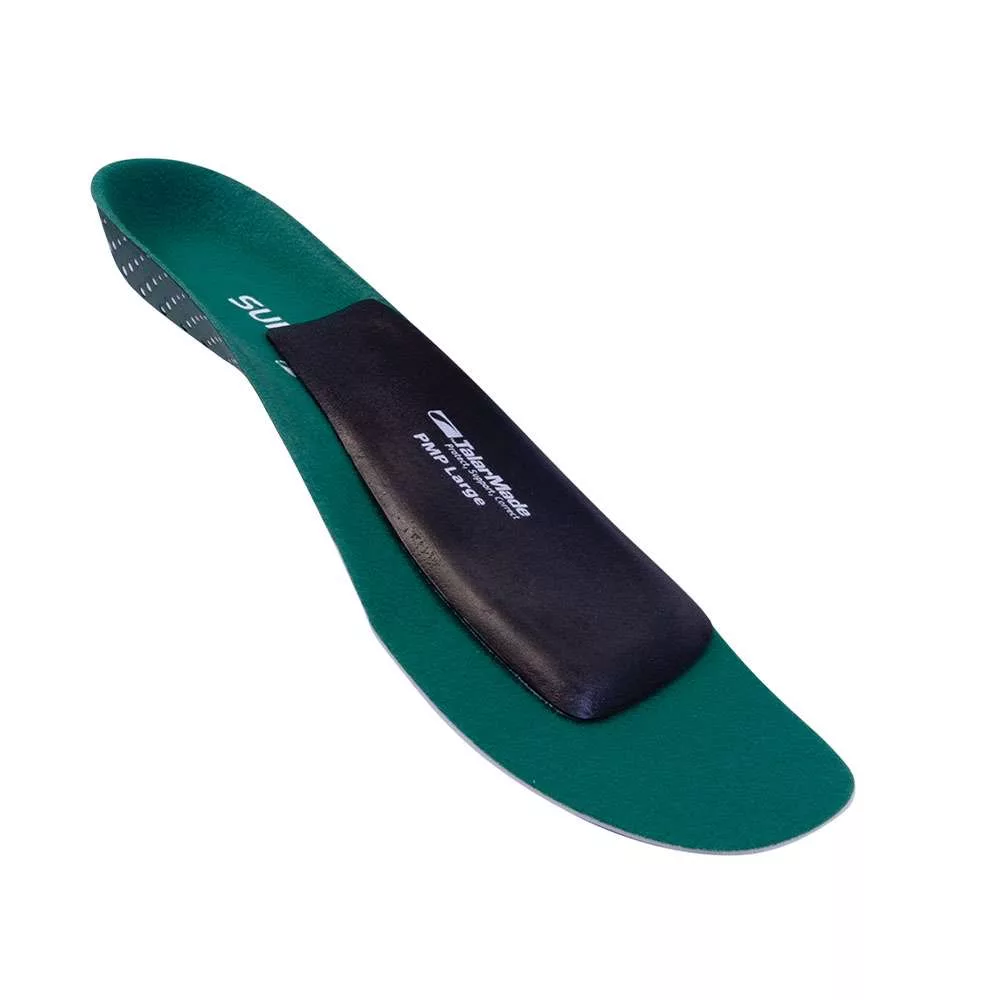
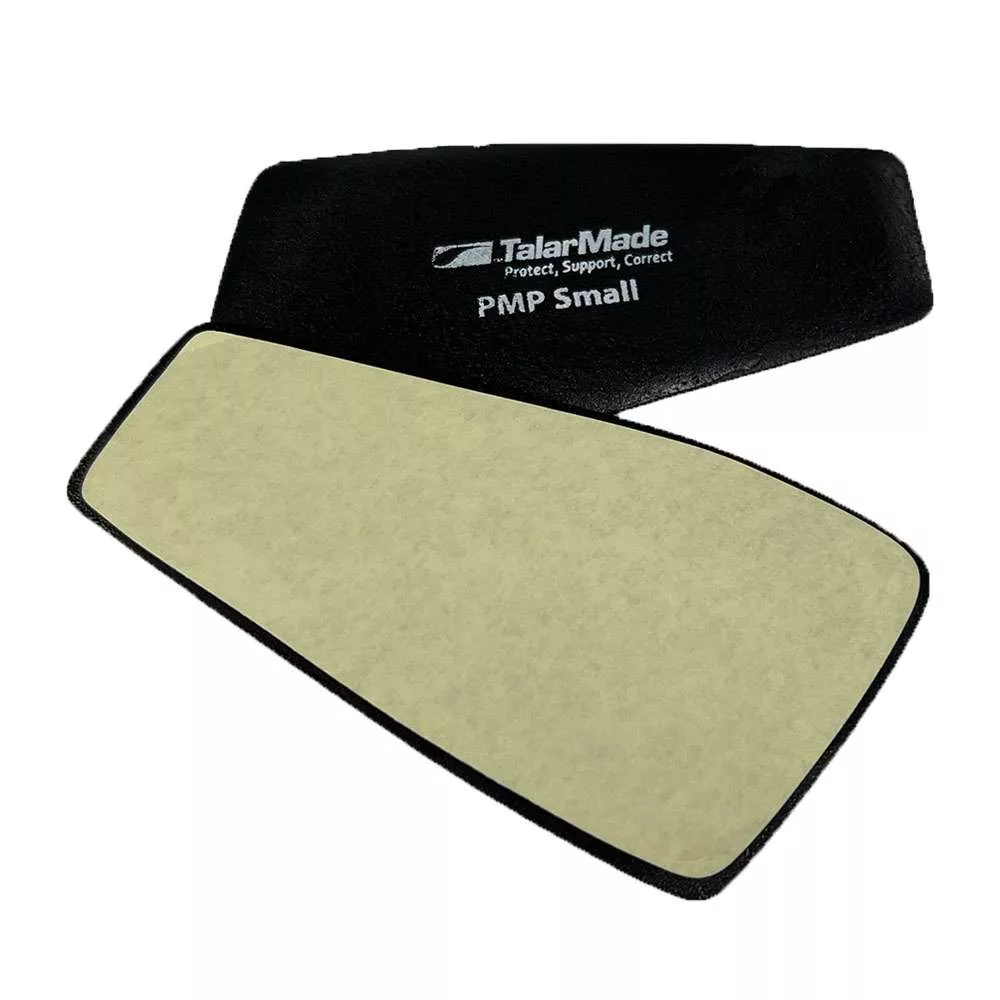
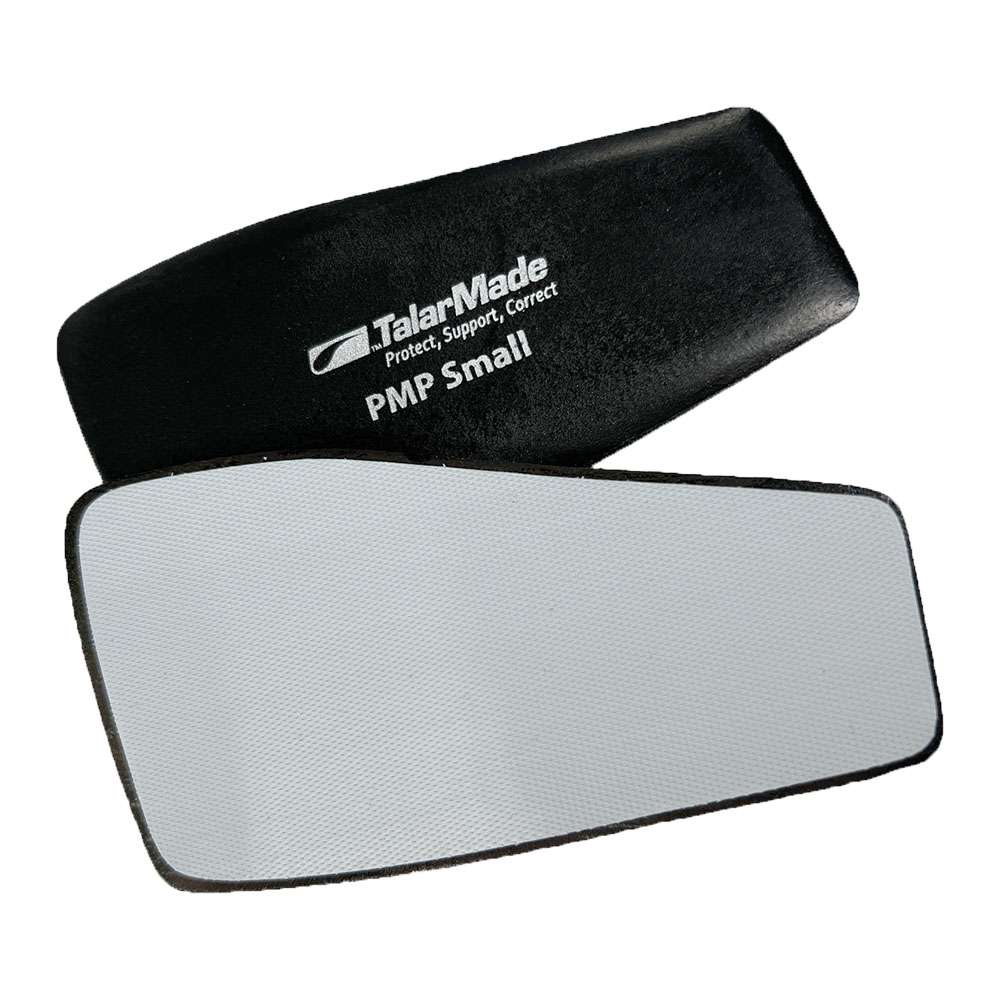
TalarMade Surface Additions (Chairside Modifications) allow clinicians to immediately customise prefabricated and custom foot orthoses during assessment or follow-up. The PMP Pad is a versatile forefoot modification based on the biomechanical principles of a Reverse Morton’s Extension. Positioned beneath metatarsal heads two to five, it redistributes forefoot loading by selectively reducing mechanical loading beneath the first metatarsal head while maintaining support beneath the lateral forefoot. By supporting the lateral metatarsals, the PMP Pad can influence first ray mechanics, modify forefoot loading patterns and alter loading through both the medial and lateral columns of the foot. Manufactured from durable polyurethane, it can also be trimmed to create customised apertures or reshaped for a wide range of forefoot modifications. Manufactured from durable polyurethane, the PMP Pad can be trimmed and modified to create customised apertures and bespoke forefoot offloading configurations, making it one of the most versatile products in the TalarMade Surface Additions (Chairside Modifications) range. Available with either: MicroGripâ„¢ – repositionable fixation for compatible TalarMade orthoses with microfibre top covers. Self-Adhesive – permanent fixation for smooth orthotic surfaces and larger orthotic devices, including carbon fibre and thermoplastic AFOs.
Price available to professional account only

Downloads, videos and product resources

Helpful product support

Use the resources below to find sizing, fitting and usage information.

Order, prescribe and train with TalarMade

Healthcare professionals can log in to view trade pricing, access account features and order eligible products.

For Healthcare Professionals

Clinical Use and Suitability

TalarMade PMP Pads provide clinicians with one of the most versatile chairside forefoot modifications available. Based on the principles of a Reverse Morton’s Extension, the pad is positioned beneath the lateral forefoot with its distal edge aligned to the digital sulcus so that metatarsal heads two to five are supported while the first metatarsal head remains relatively unloaded.

Redistributing plantar loading in this way may reduce mechanical stress beneath the first metatarsal head and encourage improved first metatarsophalangeal joint function where clinically appropriate. Supporting the lateral forefoot may also influence loading through the lateral column and can be used as part of the conservative management of selected conditions affecting the peroneal tendons and lateral ankle.

These mechanical effects make the PMP Pad suitable for the management of:

  • Functional hallux limitus
  • First ray hypermobility
  • Sesamoiditis
  • Peroneal tendinopathy
  • Lateral ankle instability

Manufactured from injection-moulded polyurethane, the PMP Pad can be readily trimmed to create customised apertures beneath symptomatic metatarsal heads or plantar lesions. This has expanded its use well beyond its original Reverse Morton’s Extension application, allowing clinicians to create highly customised forefoot offloading devices whilst maintaining support across the remainder of the forefoot.

MicroGripâ„¢ enables repeated chairside repositioning during assessment, allowing clinicians to optimise pad position before finalising treatment.

Clinical Considerations may Include

Reverse Morton’s Extension applications

  • Functional hallux limitus
  • Sesamoiditis
  • First ray hypermobility
  • Mechanical overload beneath the first metatarsal head

Lateral forefoot support applications

  • Peroneal tendinopathy
  • Lateral ankle instability
  • Altering lateral column loading
  • Modifying forefoot mechanics to influence lower limb loading

Site-specific forefoot offloading

  • Plantar plate dysfunction
  • Painful plantar corns
  • Neurovascular corns
  • Localised metatarsal head pain
  • Post-traumatic forefoot pain
  • Post-operative forefoot offloading

Modified chairside applications

Following trimming, the PMP Pad may also be used as:

  • A customised forefoot offloading pad incorporating one or more apertures
  • A broad forefoot pressure redistribution device
  • A soft Morton’s extension for patients with a dorsiflexed first ray
  • An offloading modification for larger orthoses, including carbon fibre and thermoplastic AFOs

Professional judgement should determine pad size, trimming, aperture position and fixation method according to the patient's presentation, tissue tolerance and treatment objectives.

Product specifications

Product type

TalarMade Surface Additions (Chairside Modifications)

Category

Foot Orthoses

Brand / range

PMP Pads

Intended user

Healthcare professionals modifying prefabricated or custom foot orthoses

Clinical use

Immediate chairside modification of first ray loading, lateral forefoot mechanics and customised forefoot offloading

Suitable presentations

Functional hallux limitus, sesamoiditis, first ray hypermobility, peroneal tendinopathy, lateral ankle instability, plantar plate pathology, painful corns and site-specific forefoot overload

Sizes

Small, Large

Supplied as

Available as a pair or a pack of 5 (pairs)

Product codes

Not Available

Availability

Registered professionals only

Professional pricing

Login required

Fitting, Prescribing and Product Selection Guidance

PMP Pads should be selected following biomechanical assessment and a clear understanding of the desired mechanical effect.

For use as a Reverse Morton’s Extension, position the pad beneath the lateral forefoot with the distal edge aligned to the digital sulcus. In this position, metatarsal heads two to five should remain in full contact with the pad while the first metatarsal head remains relatively unloaded.

Where customised forefoot offloading is required, the polyurethane construction allows clinicians to trim the pad and create apertures beneath symptomatic metatarsal heads or plantar lesions whilst maintaining support across the surrounding forefoot.

MicroGripâ„¢ enables clinicians to reposition the pad repeatedly during assessment, allowing optimisation of both pad position and the desired mechanical effect before treatment is finalised.

1

Consider Before Use

  • Patient presentation and treatment goals
  • Desired mechanical effect
  • Skin integrity and tissue tolerance
  • First ray function
  • Lateral column mechanics
  • Position and size of any apertures
  • Footwear compatibility
  • Patient comfort
  • Planned review and monitoring

Fitting Notes

  • Position beneath metatarsal heads two to five.
  • Align the distal edge with the digital sulcus.
  • Ensure the first metatarsal head remains relatively unloaded.
  • Maintain full contact beneath the lateral metatarsal heads.
  • Trim apertures carefully to offload symptomatic metatarsal heads where required.
  • The pad may also be trimmed to function as a soft Morton’s extension.
  • Reposition MicroGripâ„¢ versions during assessment to optimise the mechanical effect.
  • Review patient comfort and tissue response following fitting.

For further product guidance, see the downloads, videos and resources below.

Professional Trust, Evidence and Reassurance

Designed to Support Clinical Decision-Making

TalarMade Surface Additions (Chairside Modifications) provide clinicians with a rapid method of modifying forefoot mechanics without replacing the orthosis.

Originally developed as a Reverse Morton’s Extension, the PMP Pad has evolved into one of the most versatile chairside modifications within the TalarMade range. Its polyurethane construction allows clinicians to trim, reshape and customise the device to reduce first metatarsal loading, influence lateral forefoot mechanics, create targeted forefoot offloading and adapt the device to a wide range of clinical presentations.

MicroGripâ„¢ enables repeated repositioning throughout assessment, allowing clinicians to evaluate different pad positions before selecting the final treatment configuration.

Professional Reassurance Points

  • Immediate chairside modification
  • Reverse Morton’s Extension design
  • Durable injection-moulded polyurethane construction
  • Easily trimmed and customised
  • Suitable for customised aperture creation
  • Choice of MicroGripâ„¢ or Self-Adhesive fixation
  • MicroGripâ„¢ allows repeated repositioning
  • Compatible with selected TalarMade prefabricated orthoses
  • Suitable for larger orthoses including carbon fibre and thermoplastic AFOs
  • Enables rapid modification without remanufacturing the orthosis

For further product guidance, see the downloads, videos and resources below.

Professional downloads, videos and product resources

Product documentation and professional support

Access product resources to support selection, fitting, patient guidance and ordering.

Patient FAQs

Frequently asked questions

Patients requiring modification of first ray loading, lateral forefoot mechanics or customised forefoot offloading following biomechanical assessment.
Assessment should consider first ray function, lateral column mechanics, the tissue requiring offloading, desired mechanical effect, pad position, trimming requirements, footwear compatibility, patient comfort and planned review.
MicroGripâ„¢ is recommended for compatible TalarMade orthoses with microfibre top covers when repositioning or repeated chairside adjustment may be required. Self-Adhesive is recommended for smooth orthotic surfaces, permanent fixation and larger orthotic devices such as carbon fibre or thermoplastic AFOs.
TalarMade Surface Additions (Chairside Modifications) should be used with caution in patients with diabetic neuropathy, active plantar ulceration, compromised skin integrity or severe fixed deformities. Following modification, ensure the orthosis remains compatible with the patient’s footwear and monitor tissue response during follow-up.

Order, prescribe and train with TalarMade

Healthcare professionals can log in to view trade pricing, access account features and order eligible products.

Reviews

There are no reviews yet.

Be the first to review “PMP Pads”

Your email address will not be published. Required fields are marked *